
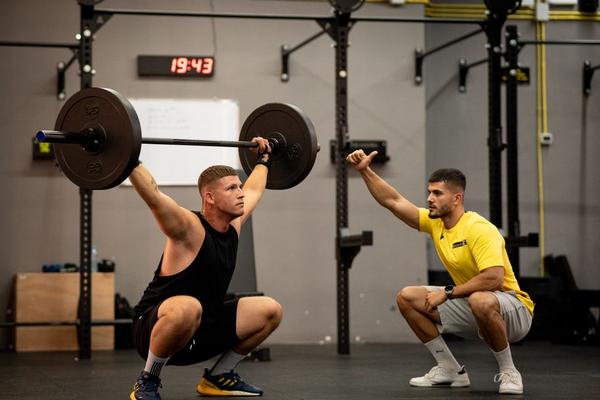
Barbell squat form is often reduced to quick cues: keep your chest up, push your knees out and squat below parallel. Those reminders can help, but they are not a complete technique. A good squat is shaped by your build, mobility, stance and bar position. Copying a short video without understanding those pieces is one reason beginners often feel awkward under the bar.
This guide explains how to squat with a barbell from setup to lockout. It focuses on the back squat and shows how to improve squat depth, control and confidence without chasing a single “perfect” look.
Start With a Stable Barbell Setup
Set the rack hooks around upper-chest height. The bar should be low enough that you can unrack it by straightening your legs, not by rising onto your toes. Position the safety arms just below the lowest point of your squat so they can catch the bar without interrupting a normal repetition.
Step under the bar and place it across the muscular shelf of your upper back. In a high-bar squat, it rests mainly on the upper traps. In a low-bar squat, it sits slightly lower across the rear shoulders. Beginners often find the high-bar position more intuitive, making it a practical starting point.
Grip the bar comfortably and create tension through your upper back. Stand up, let the bar settle, then take two or three controlled steps backwards. Avoid a long walkout, which wastes energy and is harder to repeat.
Find the Right Stance for Your Body
A useful starting stance is around shoulder width, with the toes turned out slightly. Hip structure and limb proportions vary, so one lifter may prefer a narrow stance while another needs more width.
Keep pressure across the heel, the base of the big toe and the base of the little toe. Think of each foot as a tripod. Before descending, breathe into your abdomen and sides, then brace as though preparing to absorb a firm push. Bracing means creating pressure around the trunk, not sucking your stomach in.
How to Squat With a Barbell Step by Step
Begin With Hips and Knees Together
Unlock your hips and knees at roughly the same time. Let the knees travel in the direction of the toes while the hips move down between the legs. A common mistake is pushing the hips far backwards before bending the knees, turning the squat into an exaggerated hinge.
Keep the bar moving over the middle of your feet. Your torso will lean forward to some degree, especially if you have long thighs or use a low-bar position. Forward lean is not automatically poor barbell squat form. Losing balance or allowing the bar to drift away from the mid-foot matters more than copying someone else’s torso angle.
Control Your Squat Depth
Squat depth should be as deep as you can reach while keeping your feet planted, the bar balanced and your trunk controlled. For many lifters, the hip crease reaches around the level of the top of the knee or slightly below. Do not force maximum depth if your heels rise, your balance shifts or discomfort appears.
Depth often improves through practice with a suitable stance and lighter loads. Paused squats and goblet squats can help you learn the bottom position. Ankle mobility may influence depth, but hip anatomy, stance width and limb length also matter.
Drive Up Without Losing Position
From the bottom, push the floor away and allow your hips and shoulders to rise together. Keep the knees tracking over the toes rather than forcing them as wide as possible. A sudden inward collapse that changes your balance is a sign to reduce the weight and improve control.
Continue until your hips and knees are straight. Finish tall without leaning backwards or aggressively thrusting the hips into the bar. Reset your breath and brace before the next repetition.
Common Squat Mistakes and How to Fix Them
The Heels Lift
Heel lift usually means your balance has moved forward, your stance does not suit you or you lack enough ankle movement for the depth attempted. Try turning the toes out slightly, widening the stance or using stable weightlifting shoes with a raised heel.
The Lower Back Loses Control
Some pelvic movement at the bottom is normal, but a large, sudden change under load can reduce control. Stop your descent just before that point, strengthen your brace and practise with slower repetitions. Aim for a stable, repeatable position.
The Knees Move Past the Toes
Knees travelling beyond the toes is not automatically a squat mistake. In many balanced squats, the knees move forward naturally. Trying to keep the shins vertical can push the hips too far back. Focus on whole-foot pressure, controlled knee tracking and a bar path over the mid-foot.
The Weight Is Too Heavy
Technique often changes when load increases faster than skill. Use a weight that allows every repetition to look similar. A lighter, consistent set is more useful than a heavy set held together by compensation.
How to Practise Better Barbell Squat Form
Practise often enough to build familiarity, but keep most technique work comfortably below your maximum. Sets of three to eight controlled repetitions give many beginners useful practice without excessive fatigue. Add weight gradually only when your setup, squat depth and bar path remain consistent.
Use one or two cues at a time. “Brace and keep the whole foot down” is more useful than trying to remember ten instructions during a repetition. If pain, previous injury or restricted movement makes squatting difficult, seek advice from a suitably qualified healthcare or exercise professional rather than forcing a standard position.
Frequently Asked Questions
How low should I squat with a barbell?
Squat to the deepest position you can control while keeping your feet planted, your balance over the mid-foot and your trunk stable. Around parallel or slightly below suits many lifters, but comfortable depth varies.
Should my knees go over my toes?
Yes, they can. Forward knee travel is a normal part of many squat styles. Check that the knees track with the toes, the feet stay stable and the movement remains controlled.
Why do I lean forward when I squat?
Some forward lean is necessary and depends on your proportions, stance and bar position. It becomes a problem when you lose balance, the bar moves away from the mid-foot or your torso position changes suddenly.
Should beginners use a squat pad?
A pad is not usually necessary and can make the bar feel less stable. Start with an empty bar, build upper-back tension and adjust the bar position. If the bar causes sharp pain rather than ordinary pressure, stop and check your setup.
Build a Squat You Can Repeat
Good barbell squat form is not about copying one lifter’s stance or forcing every joint into a textbook angle. It is about creating a stable setup, staying balanced over the middle of the foot, reaching a controlled depth and standing up with a consistent bar path. Learn those fundamentals with manageable loads, review your repetitions honestly and make small adjustments. A controlled, repeatable squat will give you a stronger foundation than any dramatic technique shortcut.