
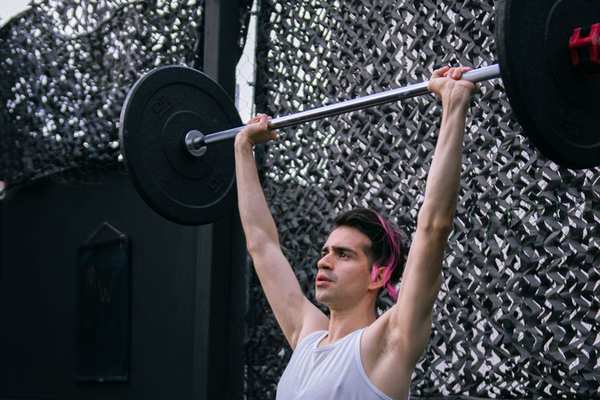
The overhead press looks simple: move a bar from shoulder height to overhead. Yet small errors in setup, balance, and bar path can turn a clean strict press into a shaky backbend. Good overhead press technique creates a stable platform so the shoulders and triceps can apply force efficiently.
The lift exposes weaknesses a bench press can hide. There is no bench for support, and a true strict press does not use the knees or hips. When the movement is performed well, the bar, wrists, elbows, ribcage, hips, and feet work as one coordinated system.
Set Up a Stable Strict Press
Place the bar in a rack at roughly upper-chest height. Grip it just outside shoulder width with your thumbs wrapped around the bar. The ideal spacing varies with shoulder width and arm length, but your forearms should be close to vertical when viewed from the front.
Rest the bar across the heel of each palm rather than letting it roll toward the fingers. Stack the wrists over the forearms and keep the elbows slightly in front of the bar. If the wrists bend far backward, the load sits behind the forearm and the press becomes less efficient.
Stand with your feet about hip-width apart and keep pressure through the whole foot. Squeeze the glutes, brace the abdomen, and keep the ribs from flaring upward. This stacked position places the ribcage over the pelvis and limits the excessive lower-back extension often seen in a heavy standing shoulder press.
Move Your Head, Not the Bar
The most efficient bar path is close to vertical over the middle of the foot. Because your head begins in that path, pull the chin slightly back as the bar leaves the shoulders. Do not send the bar forward to travel around your face. Press it close to the nose, then move your head gently forward once the bar clears your forehead.
At lockout, the bar should finish over the shoulders and mid-foot, with the elbows straight and the body balanced. Think of placing your head through a window created by your arms. This returns the body under the bar so the load is stacked rather than held in front.
Film a light set from the side. If the bar draws a large curve or finishes in front of your toes, reduce the load and practise a straighter path. An empty-bar set often reveals more than another heavy attempt.
Use the Right Pressing Sequence
Brace before the bar moves
Take a breath into the abdomen and sides of the torso, tighten the trunk, and begin without dipping the knees. The hips should not shift forward as the bar rises. If you must lean back dramatically, the load is too heavy, the bar is too far forward, or your overhead press mobility needs attention.
Drive the elbows upward
Push the bar up while keeping the forearms under it. The elbows may move slightly outward as the bar rises, but they should not begin flared directly to the sides. A position slightly forward of the torso usually allows a smoother path and gives the shoulder blades room to rotate upward.
Finish actively overhead
Lock the elbows and reach tall without jamming the shoulders downward. The shoulder blades need to move as the arms elevate. Trying to pin them permanently back and down can make a full overhead position feel restricted.
Lower the Bar with Control
Move the head back just enough to clear the bar, then lower it along the same close path to the upper chest. Keep the wrists stacked and maintain trunk tension. Allowing the bar to crash onto the shoulders can disrupt the next repetition and irritate the wrists or elbows.
For multiple reps, reset your breath and brace at the bottom. Clean repetitions build better strict press form than grinding through a set while leaning farther back on every rep.
Common Technique Problems and Fixes
The bar travels forward
This often happens when the lifter does not move the chin back, loses upper-back tension, or begins with the elbows behind the bar. Practise pressing close to the face with a light load. A wall-facing drill with an empty bar or dowel can teach a more vertical path.
The lower back arches excessively
Reduce the weight and rebuild the ribcage-over-pelvis position. Squeeze the glutes and bring the ribs down before taking a bracing breath. Half-kneeling presses and light single-arm presses can help you learn trunk control.
The wrists hurt
Check whether the bar is sitting high in the fingers with the wrists folded backward. Place it deeper in the palm and keep the knuckles angled upward. An unsuitable grip width or loading too quickly may also contribute. Persistent or sharp pain should be assessed by a qualified healthcare professional.
The shoulders feel pinched
Do not force a painful range. Try a slightly narrower grip, keep the elbows somewhat forward, and avoid pressing from behind the neck. Limited upper-back extension, shoulder flexion, or scapular control may also affect the position. A landmine press or neutral-grip dumbbell press can be a more comfortable temporary variation while you work on mobility.
How to Practise and Progress
Technique improves fastest with frequent, submaximal practice. Begin with two or three light sets, then use working weights that allow every repetition to look similar. Small increases are more productive than jumps that encourage leg drive or spinal extension.
Imagine you can press 40 kilograms for five reps, but the final two require a large lean-back. Lower the load to 35 or 37.5 kilograms and complete three controlled sets instead. Add weight only when the bar path and torso position remain consistent. That approach builds a stronger strict press rather than merely a heavier-looking one.
Natural internal linking opportunities include barbell warm-up routine, shoulder mobility exercises, and progressive overload for compound lifts.
Frequently Asked Questions
Should the bar touch the chest on every rep?
The bar should return to a consistent starting position around the upper chest or front shoulders. Do not force it lower if that collapses the wrists or pulls the elbows behind the bar.
Should I squeeze my shoulder blades together?
Create upper-back tension in the setup, but do not freeze the shoulder blades down throughout the press. They should rotate upward as the arms move overhead.
How wide should my grip be?
A grip just outside shoulder width is a useful starting point. Adjust it so the wrists stay reasonably neutral and the forearms are close to vertical at the bottom.
Why is my strict press weaker than my push press?
A push press uses leg drive to accelerate the bar, while a strict press relies on the upper body and a rigid trunk. It is normal for the strict variation to use less weight.
Build Strength on Top of Good Positions
A reliable press begins with the feet and ends with a balanced lockout. Set the wrists over the forearms, brace the trunk, move the head out of the bar’s path, and finish with the bar stacked over the middle of the foot. Practise these positions with manageable loads, address mobility limits without forcing pain, and let strength increase without sacrificing control.